The most celebratory and liberating work is that which was done, first and foremost, to satisfy the soul’s own need to speak.
There are moments when one stands before others. That particular stillness that precedes an exhale before the voice strikes a high C. That feeling of anticipation in the rustle of paper as a scholar adjusts their notes before a sea of expectant peers.
These worlds are often imagined as separate. One is said to belong to feeling, the other to thought; one to melody, the other to method. One is expressive, the other is cerebral.
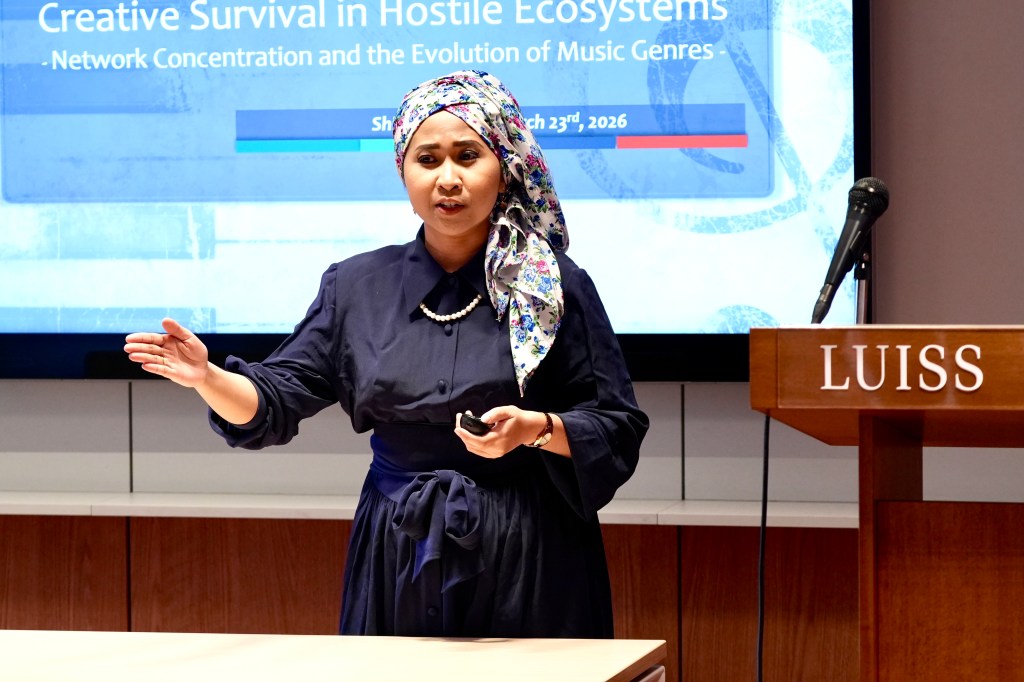
We often mistake the scholar for a stone carver—cold and detached—forgetting that the podium is merely a stage under a different light, and the thesis, a song waiting for its first note.
The stage and lecture hall are merely different altars for the same ritual.
To inhabit both the skin of the singer and the scholar is to recognise that these two worlds are not opposites, but echoes. Both demand a liberation of one’s self. Whether one is offering a meticulously gathered data set or a haunting melodic phrase, the act is identical: it is the sharing of a piece of the world one has captured.
In Élévation, Baudelaire speaks of the spirit that ‘moves with agility’ above the ‘heavy fogs’ of existence, soaring toward the ‘bright frontiers’ of the stars. This is the secret, vertical ambition of every true presentation. The ascent is the fruit of private, almost monastic labor which is never accidental.
When a scholar unveils a phenomenon they have long pursued, they are not merely reciting data; they are engaged in an act of seduction. We must remember that while expertise can often function as a wall, storytelling acts as a door. Perhaps we are never so distant from one another as we imagine. Sometimes, it takes only a single story to close the gap.
Au-dessus des étangs, au-dessus des vallées,
Élévation, Charles Baudelaire
Des montagnes, des bois, des nuages, des mers,
Par delà le soleil, par delà les éthers,
Par delà les confins des sphères étoilées,
Mon esprit, tu te meus avec agilité,
Et, comme un bon nageur qui se pâme dans l’onde,
Tu sillonnes gaiement l’immensité profonde
Avec une indicible et mâle volupté.
The presentation becomes a ceremony rather than a mere report. After all, the dry rigour of expertise is a lonely thing until it is shared. Much like the singer who lives entirely in the vibration of the moment, the academic must find the joy in the telling. For in the theatre of the mind, as on the lyric stage, one cannot truly compete with the person who has decided, quite simply, to find joy by living in the moment. A kind of presence that does not seek victory, only expression.
While the performer elevates the audience through the rhythm and melody, the scholar lifts them through the eye of the mind. The pinnacle of this shared experience is a profound catharsis. Both paths lead to the same state of grace: a moment of relief where the message has reached its mark.
Yet, when the final note fades and the crowd disperses, the performer is left with the ultimate truth of their craft.
Beyond the applause and the peer review, the act must first please the actor. The most celebratory and liberating work is that which was done, first and foremost, to satisfy the soul’s own need to speak.
 Shima Trisna
Leave a comment