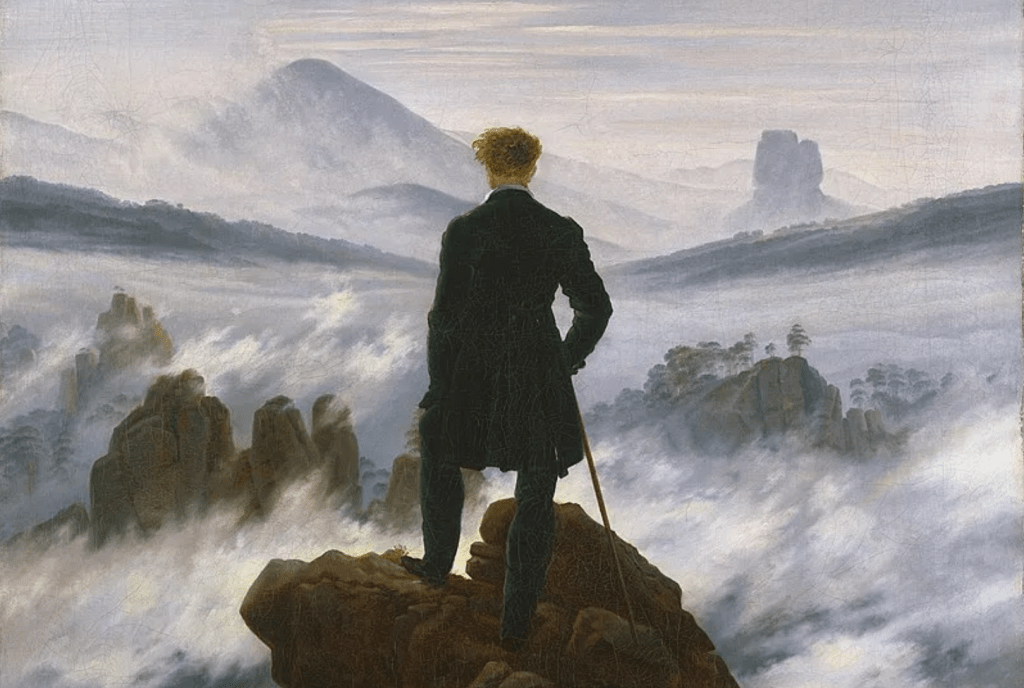
Wanderer above The Sea of Fog, Caspar David Friedrich, 1818
There is a kind of solitude that does not come from absence, but from distance. One that is not forgotten nor hidden, yet clearly placed beyond the horizon. Seen to clearly, but never fully recognised. Like a solitary figure on top of a hill surrounded by a sea of fog, the outsider occupied a paradoxical position: elevated enough to be recognised, visible, and watched, yet never quite understood.
Benjamin Britten’s Peter Grimes unfolds within this suspended state. In this opera, the borough, an English coastal village bound by routine and repetition, operates less as a community than as an unblinking eye. In this tight knit village, judgments accumulate. Peter Grimes, a fisherman of rough manners and inward dreams, moves at its edge. Physically present, but socially and emotionally misaligned. His solitude is neither chosen in full nor accidental. It is shaped slowly, by glances held too long, by judgments passed without ceremony.
Grimes is not a romantic hero. He is socially awkward, inelegant, and ill-suited to the delicate choreography of social life. However, what isolates him most is not cruelty, but ambition. He dreams of improvement… of stability, legitimacy, and a life that might one day allow him to stand upright among others. His desire is neither revolutionary nor immoral. It is modest. He only wants a future that might allow him to stand beside Ellen Orford without apology. And yet, each attempt at self-betterment seems to sharpen the village’s vigilance.
Peter Grimes invites a broader reading of outsiderhood. One that extends beyond the village and into the structures that govern recognition itself. There are figures, and even nations, who labor under standards they did not author. They are asked to prove discipline, restraint, and worth, yet are measured against standards that remain opaque and mobile. Advancement becomes a performance staged under suspicion.
The deaths of Grimes’ apprentices crystallise this condition. Tragedy occurs, ambiguity persists, and instead of responding with inquiry, the Borough responds with convergence. The crowd seeks resolution, not clarity. The outsider’s disappearance becomes sufficient explanation. Guilt is no longer a matter of evidence, but of position.

Existential thought has long traced this fragmentation between the self and the collective. Jean-Paul Sartre understood outsiderhood as a condition both liberating and annihilating. One escapes the comfort of the herd, yet also defined by it all the same. To stand apart is to surrender control over interpretation. Sartre wrote “Hell is other people” not as a condemnation of society alone, but as a recognition that identity is never fully one’s own once exposed to the gaze of others.
Yet history reminds us that defiance is not judged equally. Some transgressions are reclassified as strength, others as threat. Isabella d’Este operated politically within a Renaissance order that formally denied women authority. Her assertiveness, cushioned by lineage and legitimacy, was reframed as intelligence rather than insubordination. Her deviation was rendered admirable.
Jean Valjean, by contrast, remains suspect throughout Victor Hugo’s Les Misérables. His moral endurance never fully neutralises his lack of institutional standing. Redemption, for him, is provisional. It tends to be vulnerable to revocation. Like Peter Grimes, he inhabits a world where character alone cannot override status.
What emerges is not a rejection of hierarchy, but a more unsettling observation. Many submit willingly to structured order when authority appears coherent and competence legible. What wears down trust is arbitrariness: the sense that standards recalibrate depending on who stands before them. Improvement becomes futile when legitimacy is never truly on offer.
The Stoic philosopher Epictetus likened life to a play in which roles are assigned, not chosen. Excellence, he argued, lies in performing one’s role with dignity, regardless of its rank. Yet even this metaphor contains a quiet cruelty. Not all roles allow for reinterpretation. Some parts are written so narrowly that a slight deviation itself becomes punishable.
Peter Grimes performs his role imperfectly and pays the expected price. His tragedy is neither accidental nor exceptional. It arises from the collision between aspiration and permission, sitting at the intersection of the desire to belong and the absence of any structure that would allow belonging to materialise. The village does not merely reject him. It confirms what it already believes he is.
Perhaps the darker question Britten leaves us with is not whether glory is attainable, but whether recognition is ever granted without prior legitimacy. Whether character can truly master fate, or merely endure it. And whether there comes a moment when submission to the role one has been given ceases to be virtuous… and withdrawal, silent and final, becomes the only remaining assertion of self.
 Shima Trisna
Leave a comment