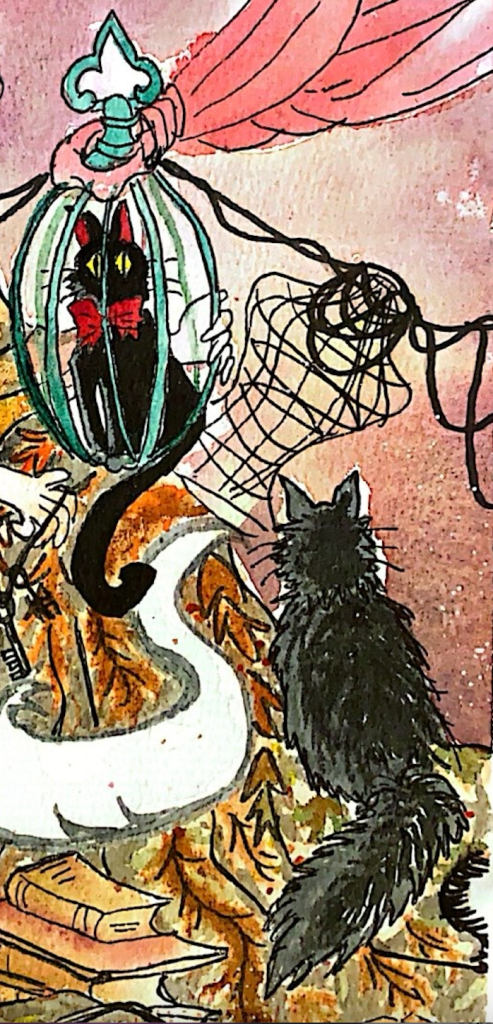
Written as a libretto to the watercolor and ink work created for Teatro dell’Opera di Roma’s La Chatte Métamorphosée en Femme.
Jacques Offenbach’s La Chatte Métamorphosée en Femme presents transformation as a playful and lighthearted illusion––theatrical, lively, and knowingly artificial. However, beneath its operetta charm, lies an inquiry which uncannily contemporary: what does it mean to transform, and where does transformation truly begin?
In Offenbach’s Pierette, the transformation is immediate and spectacular. A woman transforms into a cat. The change is dramatic, visible, and enchanting. Yet, the operetta never quite asks us to believe if the transformation is permanent. Instead, it invites us to observe it—almost with a smile—as something provisional, decorative, and perhaps incomplete.
Viewed through modern day lens, Pierette’s metamorphosis reads as a meditation on aesthetic artificiality. In an age saturated with enhancement, curation, and performance, the promise of outward refinement often masquerades as transformation itself. The operetta gently exposes this fantasy. No matter how meticulously one reshapes the exterior, without a corresponding inner shift, the essence remains unchanged. The surface may gleam, but the core resists illusion.
This tension echoes a familiar literary lineage. Like Oscar Wilde’s The Picture of Dorian Gray, Offenbach’s piece flirts with the seduction of appearances divorced from inner life. The contrast lies in the ending. While Wilde descends into tragedy, Offenbach opts for wit and levity. Both, however, gesture toward the same truth: when transformation bypasses the interior, it curdles into artifice.
At the heart of the operetta, there is Marianne, whose choice to masquerade as a cat not born of vanity, but longing. Longing for love, longing for connection. Her transformation is an act of desire—an attempt to earn affection through self-erasure rather than presence.
In this reading, Marianne is neither foolish nor contemptible. She is painfully human. Her mistake is not the desire to be loved, but the belief that love requires disappearance.
Guido’s preference for Minetta, the cat, further complicates this dynamic. It is almost tempting to label his attachment to his furry companion as frivolous. However, it reveals a quiet truth. Guido inhabits a constrained world—one where companionship without expectation feels safer than intimacy burdened by responsibility. In this sense, Minette becomes less a pet than a symbol. She is a projection of longing for affection unencumbered by obligation, devotion without demand. She represents a form of love that feels attainable, uncomplicated, and contained.
Henceforth, Minette may be read as a metaphor for the feminine ideal as fantasy. Loyal, comforting, and silent. A home to return to.
Marianna’s tragic miscalculation is assuming that embodying this fantasy will make her chosen. Yet the operetta subtly suggests that desire built on masquerade can never resolve itself into intimacy.
What emerges from Offenbach’s playful narrative is a cautionary meditation, not a moral scold. Transformation, the operetta implies, can not be conjured solely through disguise. There is no magic, no shortcut, no alchemy that converts performance into becoming. When change is pursued through form only—through costume, gesture, or surface—it remains suspended, provisional, and fragile.
True refinement is not a rejection of beauty, nor an indictment of decoration. Rather, it is an alignment. An inward disposition gradually shaping outward form. A harmonious interaction between essence and expression. Offenbach’s piece, in all its playfulness, reminds us that metamorphosis without inner movement is merely theatre. One thing about theatre is… once the curtain falls, it dissolves.
In this sense, La Chatte métamorphosée en femme endures not because it promises transformation, but because it questions it. And in doing so, it offers a quiet, enduring insight: refinement must be both inward and outward, or it is nothing more than a charming illusion.
 Shima Trisna
Leave a comment